Research
Our group investigates the fundamental physics of interacting electrons and excitons in low-dimensional quantum materials.
By stacking atomically thin van der Waals crystals into novel heterostructures, we create highly tunable platforms to
isolate and control exotic states of matter. Our group combines precision nanoscale device fabrication with advanced optical
spectroscopy and electrical transport to probe these systems. We explore a diverse landscape of quantum phenomena,
including strongly correlated states in moiré heterostructures, artificially designed dielectric lattices, correlated
electron-hole fluids, and emerging 2D magnetic semiconductors. Ultimately, our goal is to realize controllable
quantum phases and pioneer new methods for uncovering next-generation quantum materials.
Exciton and Correlated Moiré Physics
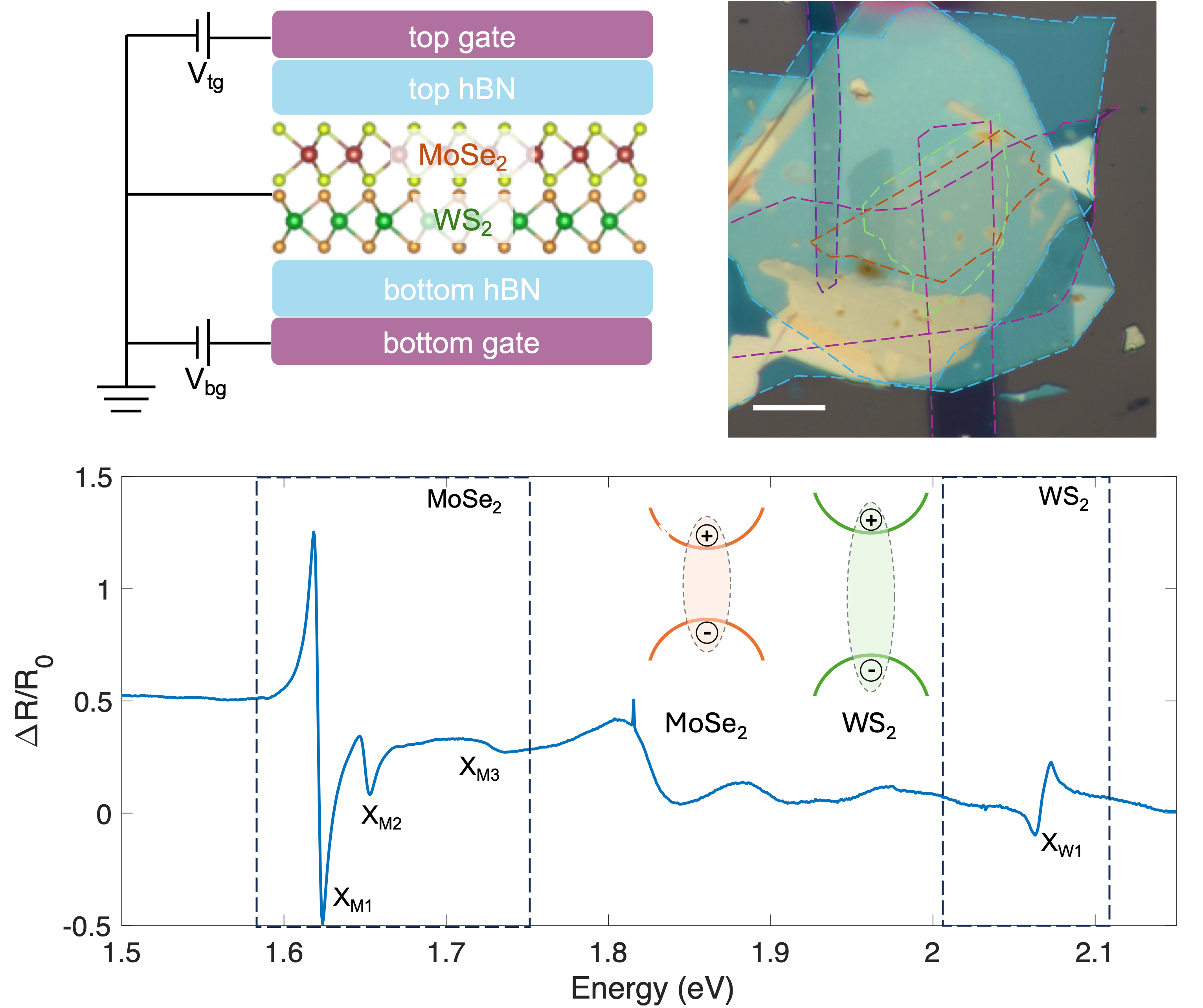
2D van der Waals materials can be stacked to create arbitrary heterostructures that exhibit exotic quantum properties. Introducing a relative twist angle between these atomically thin layers creates a spatially varying moiré potential, opening a massive phase space to search for novel correlated states. While these states are traditionally observed via electrical transport, creating reliable Ohmic contacts in semiconducting transition metal dichalcogenides (TMDs) remains a significant challenge. To overcome this, our lab probes these states using novel optical spectroscopy, studying the excitons in the moiré lattice. Because these excitons are sensitive to the dielectric environment, we can optically detect the electronic state. Furthermore, we can design devices to use electrically driven techniques, such as the optical detection of resistance and capacitance (ODRC) technique. We leverage these strong light-matter interactions to map out complex correlated phases, utilizing in situ electric fields to control electron localization and uncover strongly correlated phenomena like Mott insulators and generalized Wigner crystals.
Select relevant work
- Layer-tunable Hubbard bands probed via moiré excitons in MoSe$_2$/WS$_2$ heterostructures
Hongyu Yao, Qiao Li, Chih-En Hsu, Takashi Taniguchi, Kenji Watanabe, Hung-Chung Hsueh, Zhenglu Li, Andrew Y. Joe
arXiv:2606.25071 (2026) - 2p interlayer exciton revealed by hybridization in bilayer MoS$_2$
Soonyoung Cha, Zhaoran Xu, Tianyi Ouyang, Hongyu Yao, Raj Kumar Paudel, Takashi Taniguchi, Kenji Watanabe, Andrew Y. Joe, Yia-Chung Chang, Nathaniel M. Gabor, Chun Hung Lui
Research Square Preprint, rs-6734783 (2025) - Excitons in a reconstructed moiré potential in twisted WSe$_2$/WSe$_2$ homobilayers
Trond I. Andersen, Giovanni Scuri, Andrey Sushko, Kristiaan De Greve, Jiho Sung, You Zhou, Dominik S. Wild, Ryan J. Gelly, Hoseok Heo, Damien Bérubé, Andrew Y. Joe, Luis A. Jauregui, Kenji Watanabe, Takashi Taniguchi, Philip Kim, Hongkun Park, Mikhail D. Lukin
Nature Materials 20, 480 (2021)
Interlayer Excitons towards the Bose-Hubbard Model
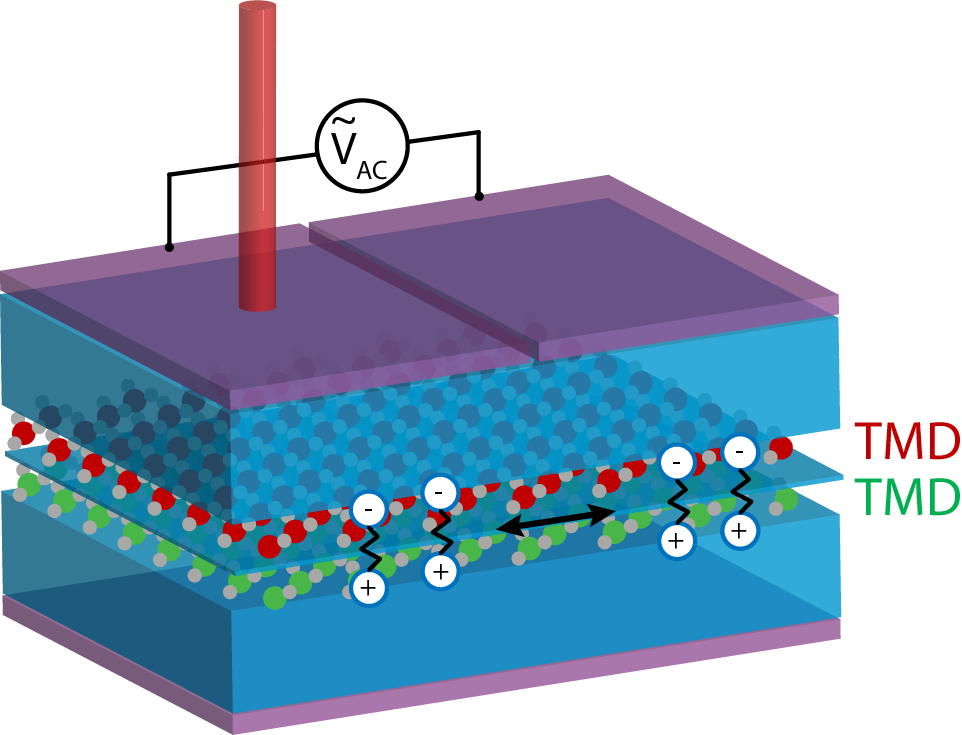
Distinct from using excitons purely as optical probes, we also investigate the fundamental physics of interlayer excitons and strongly correlated electron-hole fluids. By independently tuning the charge density in closely spaced conducting layers, we can engineer solid-state systems governed by the Bose-Hubbard model. This platform allows us to study the thermodynamic behavior of correlated electron-hole fluids and realize perfect Coulomb drag in an excitonic insulator. Through precise electrical and optical control, we explore how these macroscopic quantum states condense, transport, and interact, providing a highly tunable environment for the quantum simulation of interacting bosons and fermions.
Select relevant work
- Perfect Coulomb Drag and Exciton Transport in an Excitonic Insulator
Ruishi Qi, Andrew Y. Joe, Zuocheng Zhang, Jingxu Xie, Qixin Feng, Zheyu Lu, Ziyu Wang, Takashi Taniguchi, Kenji Watanabe, Sefaattin Tongay, Feng Wang
Science 388, 6744, 278 (2025) - Controlled Interlayer Exciton Ionization in an Electrostatic Trap in Atomically Thin Heterostructures
Andrew Y. Joe, Andrés M. Mier Valdivia, Luis A. Jauregui, Kateryna Pistunova, Dapeng Ding, You Zhou, Giovanni Scuri, Kristiaan De Greve, Andrey Sushko, Bumho Kim, Takashi Taniguchi, Kenji Watanabe, James Hone, Mikhail D. Lukin, Hongkun Park, Philip Kim
Nature Communications 15, 6743 (2024) - Thermodynamic behavior of correlated electron-hole fluids in van der Waals heterostructures
Ruishi Qi, Andrew Y. Joe, Zuocheng Zhang, Yongxin Zeng, Tiancheng Zheng, Qixin Feng, Emma Regan, Jingxu Xie, Zheyu Lu, Takashi Taniguchi, Kenji Watanabe, Sefaattin Tongay, Michael F. Crommie, Allan H. MacDonald, Feng Wang
Nature Communications 14, 8264 (2023)
Designable Quantum Simulators
Beyond naturally occurring twisted moiré superlattices, our group is pioneering a versatile platform for designing correlated electronic physics from the bottom up. We create artificial lattices by etching periodic nanopatterns directly into dielectric substrates like SiO$_2$ and hBN. By imposing these periodic potentials onto pristine TMD monolayers, we introduce electrically tunable superlattice potentials that break free from standard moiré geometric constraints. This highly flexible nanopatterning approach allows us to artificially engineer the electronic band structure, aiming to realize interaction-driven topological flat bands and quantum phase transitions. Ultimately, this technique provides a robust, programmable method to explore exotic correlated phases without relying on twist-angle fabrication.

Emerging 2D van der Waals Materials
Building on our foundational work in transition metal dichalcogenides, we are actively expanding our optical and transport methodologies to explore novel quantum states hosted in a broader class of emerging van der Waals materials. This research thrust serves as a platform to uncover the fundamental physical interplay between different quantum phases in the ultra-thin limit. We investigate a diverse array of layered materials exhibiting intrinsic electronic and magnetic orders. For example, we are exploring the excitons that exist in 2D layered antiferromagnets and their interaction with magnetic order. By extending our specialized spectroscopic and device fabrication techniques to these new systems, we aim to uncover novel, electrically programmable quantum phases.
Select relevant work
- Transport Study of Charge Carrier Scattering in Monolayer WSe$_2$
Andrew Y. Joe, Kateryna Pistunova, Kristen Kaasbjerg, Ke Wang, Bumho Kim, Daniel A. Rhodes, Takashi Taniguchi, Kenji Watanabe, James Hone, Tony Low, Luis A. Jauregui, Philip Kim
Physical Review Letters 132, 056303 (2024)